
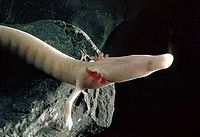
 The olm, or proteus (Proteus anguinus), is a blind amphibian endemic to the subterranean waters of caves of the Dinaric karst
of Central and Southeastern Europe. It lives in the waters that flow
underground through this extensive limestone region, including waters of
the Soča river basin near Trieste, Italy, through to southern Slovenia, southwestern Croatia, and Herzegovina.The olm is the only species in the Proteus genus, the only European species of the Proteidae family, and the only cave-dwelling chordate found only in Europe. It is also occasionally called the "human fish" by locals because of its skin color, similar to that of white people (translated literally from Slovene: človeška ribica and Croatian: čovječja ribica), as well as "cave salamander" or "white salamander." In Slovenia, it is also known by the name močeril, which translates as "the one that burrows into wetness."
The olm, or proteus (Proteus anguinus), is a blind amphibian endemic to the subterranean waters of caves of the Dinaric karst
of Central and Southeastern Europe. It lives in the waters that flow
underground through this extensive limestone region, including waters of
the Soča river basin near Trieste, Italy, through to southern Slovenia, southwestern Croatia, and Herzegovina.The olm is the only species in the Proteus genus, the only European species of the Proteidae family, and the only cave-dwelling chordate found only in Europe. It is also occasionally called the "human fish" by locals because of its skin color, similar to that of white people (translated literally from Slovene: človeška ribica and Croatian: čovječja ribica), as well as "cave salamander" or "white salamander." In Slovenia, it is also known by the name močeril, which translates as "the one that burrows into wetness."This animal is most notable for its adaptations to a life of complete darkness in its underground habitat. The olm's eyes are undeveloped, leaving it blind, while its other senses, particularly those of smell and hearing, are acutely developed. It also lacks any pigmentation in its skin. In contrast to most amphibians, the olm is entirely aquatic, and it eats, sleeps, and breeds underwater. It has three toes on its forelimbs, but two toes on its hind feet. It also exhibits neoteny, retaining larval characteristics like external gills into adulthood, like the American amphibians, the axolotl and the mud
Anatomy
External appearance
The olm's body is snakelike, 20–30 cm (8–12 in) long, with some specimens reaching up to 40 centimetres (16 in).The trunk is cylindrical, uniformly thick, and segmented with regularly spaced furrows at the myomere borders. The tail is relatively short, laterally flattened, and surrounded by a thin fin. The limbs are small and thin, with a reduced number of digits compared to other amphibians: the front legs have three digits instead of the normal four, and the rear have two digits instead of five. Its body is covered by a thin layer of skin, which contains very little of the pigment riboflavin,making it yellowish-white or pink in color.The internal organs can be seen shining through on the abdominal part of the body. The resemblance in color to that of white humans is the reason why the Proteus is called human fish in some languages. However, the olm's skin retains the ability to produce melanin. When exposed to light, it will gradually turn dark, and in some cases the larvae are also colored. Its pear-shaped head ends with a short, dorsoventrally flattened snout. The mouth opening is small, with tiny teeth forming a sieve to keep larger particles inside the mouth. The nostrils are so small as to be imperceptible, but are placed somewhat laterally near the end of the snout. The regressed eyes are covered by a layer of skin. The olm breathes with external gills that form two branched tufts at the back of the head.They are red in color because the oxygen-rich blood shows through the non-pigmented skin. The olm also has rudimentary lungs, but their role in respiration is only accessory. The sexes are very similar in appearance, with males having a somewhat thicker cloaca than females.Sensory organs
Cave-dwelling animals have been prompted, among other adaptations, to develop and improve non-visual sensory systems in order to orient in and adapt to permanently dark habitats. The olm's sensory system is also adapted to life in the subterranean aquatic environment. Unable to use vision for orientation, the olm compensates with other senses, which are better developed than in amphibians living on the surface. It retains larval proportions, like a long, slender body and a large, flattened head, and is thus able to carry a larger number of sensory receptors.Photoreceptors
The eyes are regressed, but retain sensitivity to light. They lie deep below the dermis of the skin and are rarely visible except in some younger adults. Larvae have normal eyes, but development soon stops and they start regressing, finally atrophying after four months of development. The pineal body also has photoreceptive cells which, though regressed, retain visual pigment like the photoreceptive cells of the regressed eye. The pineal gland in Proteus probably possesses some control over the physiological processes.Behavioral experiments revealed that the skin itself is also sensitive to light.Photosensitivity of the integument is due to the pigment melanopsin inside specialized cells called melanophores. Preliminary immunocytochemical analysis support the existence of photosensitive pigment also in the animal's integument.Chemoreceptors
 Mechano- and electroreceptors
The sensory epithelia of the inner ear are very specifically differentiated, enabling the olm to receive sound waves in the water, as well as vibrations
from the ground. The complex functional-morphological orientation of
the sensory cells enables the animal to register the sound sourcesLittle is known about the hearing of Proteus, but occasionally observed reactions to sounds indicate its possibility (Bulog, personal observ.).As this animal stays neotenic
throughout its long life span, it is only occasionally exposed to
normal adult hearing in air which is probably also possible for Proteus
as in most salamanders. Hence, it would be of adaptive value in caves,
with no vision available, to profit from underwater hearing by
recognizing particular sounds and eventual localization of prey or other
sound sources, i.e. acoustical orientation in general. The ethological
experiments indicate that the best hearing sensitivity of Proteus is between 10 Hz and up to 15,000 Hz. The lateral line supplements inner ear sensitivity by registering low-frequency nearby water displacements.A new type of sensory organ has been analyzed on the head of Proteus, utilizing light and electron microscopy. These new organs have been described as ampullary organs. Like some other lower vertebrates, the olm has the ability to register weak electric fields.Some behavioral experiments suggest that the olm may be able to use Earth's magnetic field to orient itself. Recently, Proteus anguinus has been found to align itself with natural and artificially modified magnetic fields.
Ecology and life history
 The olm's embryonic
development takes 140 days, after which it takes another 14 years to
reach sexual maturity. The larvae gain adult appearance after nearly
four months, with the duration of development strongly correlating with
water temperature. Unconfirmed historical observations of vivipary exist, but it has been shown that the females possess a gland that produces the egg casing, similar to those of fish and egg-laying amphibians.
It was long thought that female olm gave birth to live young at lower
temperatures and laid eggs at higher, but rigorous observations have not
confirmed that. The olm appears to be oviparous.
The olm's embryonic
development takes 140 days, after which it takes another 14 years to
reach sexual maturity. The larvae gain adult appearance after nearly
four months, with the duration of development strongly correlating with
water temperature. Unconfirmed historical observations of vivipary exist, but it has been shown that the females possess a gland that produces the egg casing, similar to those of fish and egg-laying amphibians.
It was long thought that female olm gave birth to live young at lower
temperatures and laid eggs at higher, but rigorous observations have not
confirmed that. The olm appears to be oviparous. The female lays up to 70 eggs, each about 12 millimetres (0.5 in) in
diameter, and places them between rocks, where they remain under her
protection. The tadpoles are 2 centimetres (0.8 in) long when they hatch
and live on yolk stored in the cells of the digestive tract for a month.
The female lays up to 70 eggs, each about 12 millimetres (0.5 in) in
diameter, and places them between rocks, where they remain under her
protection. The tadpoles are 2 centimetres (0.8 in) long when they hatch
and live on yolk stored in the cells of the digestive tract for a month.Development of the olm and other troglobite amphibians is characterized by heterochrony – the animal does not undergo metamorphosis and instead retains larval features. The form of heterochrony in the olm is neoteny – delayed somatic maturity with precocious reproductive maturity, i.e. reproductive maturity is reached while retaining the larval external morphology. In other amphibians, the metamorphosis is regulated by the hormone thyroxine, excreted by the thyroid gland. The thyroid is normally developed and functioning in the olm, so the lack of metamorphosis is due to the unresponsiveness of key tissues to thyroxine.
Olms are gregarious, and usually aggregate either under stones or in fissures. Sexually active males are an exception, establishing and defending territories where they attract females. The scarcity of food makes fighting energetically costly, so encounters between males usually only involve display. This is a behavioral adaptation to life underground.
Reproduction has only been observed in captivity so far. Sexually mature males have swollen cloacas, brighter skin color, two lines at the side of the tail, and slightly curled fins. No such changes have been observed in the females. The male can start courtship even without the presence of a female. He chases other males away from the chosen area, and may then secrete a female-attracting pheromone. When the female approaches, he starts to circle around her and fan her with his tail. Then he starts to touch the female's body with his snout, and the female touches his cloaca with her snout. At that point, he starts to move forward with a twitching motion, and the female follows. He then deposits the spermatophore, and the animals keep moving forward until the female hits it with her cloaca, after which she stops and stands still. The spermatophore sticks to her and the sperm cells swim inside her cloaca where they attempt to fertilize her eggs. The courtship ritual can be repeated several times over a couple of hours.
Longevity is estimated at up to 58 years. Individual specimens have been kept under semi-natural conditions in concrete basins for up to 70 years. A study published in Biology Letters estimated that they have a maximum lifespan of over 100 years and that the lifespan of an average adult is around 68.5 years. When compared to the longevity and body mass of other amphibians, olms are outliers, living longer than would be predicted from their size.
Taxonomic history
Olms from different cave systems differ substantially in body measurements, color and some microscopic characters. Earlier researchers used these differences to support the division into five different species, while modern herpetologists understand that external morphology is not reliable for amphibian systematics and can be extremely variable, depending on nourishment, illness, and other factors even varying among individuals in a single population. Proteus anguinus is now considered a single species. The length of the head is the most obvious difference among various populations – individuals from Stična, Slovenia, have shorter heads on average than those from Tržič, Slovenia, and the Istrian peninsula, for example.Black Proteus
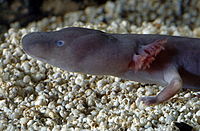
 It has several features separating it from the type subspecies:
| Feature | Proteus anguinus anguinus | Proteus anguinus parkelj | Notes |
|---|---|---|---|
| Skin | Not pigmented. | Normally pigmented, dark brown, or black in color. | The most obvious difference. |
| Head shape | Long, slender. | Shorter, equally thick. Stronger jaw muscles visible as two bulbs on the top of the head. | |
| Body length | Shorter, 29–32 vertebrae. | Longer, 34–35 vertebrae. | Amphibians do not have a fixed number of vertebrae. |
| Appendages | Longer. | Shorter. | |
| Tail | Longer in proportion to the rest of the body. | Shorter in proportion. | |
| Eyes | Regressed. | Almost normally developed, although still small compared to other amphibians. Covered by a thin layer of transparent skin, no eyelids. | Regressed eye of White Proteus shows first of all immunolabelling for the red-sensitive cone opsin. The eye of Black Proteus has principal rods, red-sensitive cones and blue- or UV- sensitive cones. |
| Other senses | Specific and highly sensitive. | Some sensory organs, particularly electroreceptors, less sensitive. | Not very obvious. |
Research history
 The olm is supposedly first pictured as two pairs of snakes with wings, which could represent gills, in a relief on a Venetian stone fountain, probably originating from Karst.
The first written mention of the olm is in Janez Vajkard Valvasor's The Glory of the Duchy of Carniola (1689) as a baby dragon. Heavy rains of Slovenia would wash the olms up from their subterranean habitat, giving rise to the folklore belief that great dragons lived beneath the Earth's crust, and the olms were the undeveloped offspring of these mythical beasts. In The Glory of the Duchy of Carniola, Valvasor compiled the local Slovenian folk stories and pieced together the rich mythology of the creature and documented observations of the olm as "Barely a span long, akin to a lizard, in short, a worm and vermin of which there are many hereabouts".
The olm was used by Charles Darwin in his famous On the Origin of Species as an example for the reduction of structures through disuse:
Far from feeling surprise that some of the cave-animals should be very anomalous...as is the case with blind Proteus with reference to the reptiles of Europe, I am only surprised that more wrecks of ancient life have not been preserved, owing to the less severe competition to which the scanty inhabitants of these dark abodes will have been exposed.
Conservation status
 The olm is extremely vulnerable to changes in its environment due to
its adaptation to the specific conditions in caves. Water resources in
the karst are extremely sensitive to all kinds of pollution.
The contamination of the karst underground waters is due to the large
number of waste disposal sites leached by rainwater, as well as to the
accidental overflow of various liquids. The reflection of such pollution
in the karst underground waters depends on the type and quantity of
pollutants, and on the rock structure through which the waters
penetrate. Self-purification processes in the underground waters are not
completely understood, but they are quite different from those in
surface waters. Among the most serious chemical pollutants are chlorinated hydrocarbon pesticides, fertilizers, polychlorinated biphenyls (PCBs),
which are or were used in a variety of industrial processes and in the
manufacture of many kinds of materials; and metals such as mercury,
lead, cadmium, and arsenic. All of these substances persist in the
environment, being slowly, if at all, degraded by natural processes. In
addition, all are toxic to life if they accumulate in any appreciable
quantity. Slovenian caves became famous for the animals they contained
and which could not be found elsewhere. Due to its rarity the olm is
also popular among collectors, which can threaten the species by taking
too many animals out of the habitat.
The olm is extremely vulnerable to changes in its environment due to
its adaptation to the specific conditions in caves. Water resources in
the karst are extremely sensitive to all kinds of pollution.
The contamination of the karst underground waters is due to the large
number of waste disposal sites leached by rainwater, as well as to the
accidental overflow of various liquids. The reflection of such pollution
in the karst underground waters depends on the type and quantity of
pollutants, and on the rock structure through which the waters
penetrate. Self-purification processes in the underground waters are not
completely understood, but they are quite different from those in
surface waters. Among the most serious chemical pollutants are chlorinated hydrocarbon pesticides, fertilizers, polychlorinated biphenyls (PCBs),
which are or were used in a variety of industrial processes and in the
manufacture of many kinds of materials; and metals such as mercury,
lead, cadmium, and arsenic. All of these substances persist in the
environment, being slowly, if at all, degraded by natural processes. In
addition, all are toxic to life if they accumulate in any appreciable
quantity. Slovenian caves became famous for the animals they contained
and which could not be found elsewhere. Due to its rarity the olm is
also popular among collectors, which can threaten the species by taking
too many animals out of the habitat.The olm is included in Appendices II and IV of the EU Habitats Directive (92/43/EEC). Appendix II seeks to preserve favorable conservation status in animal and plant species along with their habitats by protecting the species or defining special areas of conservation. These areas of conservation form the Natura 2000 network. Appendix IV further defines "animal and plant species of community interest in need of strict protection." Hunting or keeping a limited number of olm is allowed only under strictly controlled circumstances, determined by local authorities.
The olm was first protected in Slovenia in 1922 along with all cave fauna, but the protection was not effective and a substantial black market came into existence. In 1982 it was placed on a list of rare and endangered species. This list also had the effect of prohibiting trade of the species. After joining the European Union, Slovenia had to establish mechanisms for protection of the species included in the EU Habitats Directive. The olm is included in a Slovenian Red list of endangered species. Postojna Cave and other caves inhabited by the olm were also included in the Slovenian part of the Natura 2000 network.
In Croatia, the olm is protected by the legislation designed to protect amphibians– collecting is possible only for research purposes by permission of the National Administration for Nature and Environment Protection. Conservation status in Bosnia and Herzegovina and Montenegro has not yet been defined.
On the IUCN Red List, the olm is listed as vulnerable because of its fragmented and limited distribution and ever-decreasing population.
Cultural significance
The olm is a symbol of Slovenian natural heritage. The enthusiasm of scientists and the broader public about this inhabitant of Slovenian caves is still strong 300 years after its discovery. Postojna Cave is one of the birthplaces of speleobiology due to the olm and other rare cave inhabitants, such as the blind cave beetle. The image of the olm contributes significantly to the fame of Postojna Cave, which Slovenia successfully utilizes for the promotion of ecotourism in Postojna and other parts of Slovenian karst. Tours of Postojna Cave also include a tour around the speleobiological station – the Proteus vivarium, showing different aspects of the cave environment.The olm was also depicted on one of the Slovenian tolar coins, and was the namesake of Proteus, the oldest Slovenian popular science magazine, first published in 1933




 Posts
Posts



No Response to "Olm "
Post a Comment