


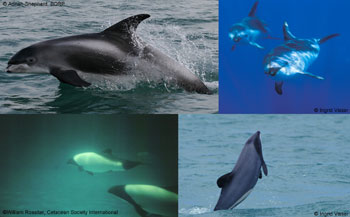
The word cetacean is used to describe all whales, dolphins and porpoises in the order Cetacean. This word comes from the Latin Cetus meaning "a large sea animal," and the Greek word ketos, meaning "sea monster."
There are about 86 species of cetaceans. The term "about" is used because as scientists learn more about these fascinating animals, new species are discovered or populations are re-classified.
There are about 86 species of cetaceans. The term "about" is used because as scientists learn more about these fascinating animals, new species are discovered or populations are re-classified.
Cetaceans range in size from the tiniest dolphin, Hector's
dolphin, which is just over 39 inches long, to the largest whale, the blue whale, which can be over 100 feet long. Cetaceans live in all of the oceans and many of the major rivers of the world.
Cetaceans are thought to have evolved from hooved land mammals that lived about 50 million years ago.
Cetaceans are thought to have evolved from hooved land mammals that lived about 50 million years ago.
Types of Cetaceans:
There are many types of cetaceans, which are divided largely according to how they feed.
The order Cetacean is divided into two sub-orders, the Mysticism (baleen whales) and the Odontocetes (toothed whales). The Odontocetes are more numerous, comprising 72 different species, compared to 14 baleen whale species.
The Mysticism include species such as the blue whale, fin whale, right whale and humpback whale.
The order Cetacean is divided into two sub-orders, the Mysticism (baleen whales) and the Odontocetes (toothed whales). The Odontocetes are more numerous, comprising 72 different species, compared to 14 baleen whale species.
The Mysticism include species such as the blue whale, fin whale, right whale and humpback whale.
Mysticism have hundreds of comb-like plates of baleen hanging from their upper jaw. Baleen whales
feed by gulping large amounts of water containing hundreds or thousands
of fish or plankton, then forcing the water out in between the baleen
plates, leaving the prey inside to be swallowed whole.
Odontocetes include the sperm whale, orca (killer whale), beluga and all of the dolphins and porpoises. These animals have cone-shaped or spade-shaped teeth and usually capture one animal at a time and swallow it whole. Odontocetes feed mostly on fish and squid, although some orcas prey on other marine mammals.
Odontocetes include the sperm whale, orca (killer whale), beluga and all of the dolphins and porpoises. These animals have cone-shaped or spade-shaped teeth and usually capture one animal at a time and swallow it whole. Odontocetes feed mostly on fish and squid, although some orcas prey on other marine mammals.
Cetacean Characteristics:
Cetaceans
are mammals, which means they are endothermic (commonly called
warm-blooded) and their internal body temperature is about the same as a
human's. They give birth to live young and breathe air through lungs
just like we do. They even have hair.
Unlike fish, which swim by moving their heads from side-to-side to swing their tail, cetaceans propel themselves by moving their tail in a smooth, up-and-down motion. Some cetaceans, such as the Dall's porpoise and the orca (killer whale) can swim faster than 30 miles per hour.
Unlike fish, which swim by moving their heads from side-to-side to swing their tail, cetaceans propel themselves by moving their tail in a smooth, up-and-down motion. Some cetaceans, such as the Dall's porpoise and the orca (killer whale) can swim faster than 30 miles per hour.


 Posts
Posts



No Response to "Cetaceans - Whales, Dolphins and Porpoises"
Post a Comment